
how to use substack to get everything you want
I said what I said. the official internet bedroom guide to the substack to self-publishing pipeline.

I’m pretty sure that I came into the world with the same level of delusion and self-assuredness about what I am here to do as I have now. I once kissed a boy and immediately told him that he should stop seeing the other girl and be my boyfriend instead. Eventually, I realized he was a terrible person and the other girl was a brilliant, amazing, sweet, beautiful, kind person, so I gave up on him and became her friend.
But not before he pulled back from our kiss and told me, “You’re bold, Rachel.”
And I am.
So bold I sold over 500 copies of my new book, In the Girls’ Room without a publisher, marketing team, huge ass following online. None of it. What I had when I started was a manuscript I’d spent ten years writing (never again!!), a brush with death, two years of writing for substack, and a will to make do with what I had inherited from my grandmothers, one who grew up in rural Kansas on a dirt farm and the other who started smoking when she was 13 and never quit.
This isn’t going to be a guide to making a million dollars on substack or how to get thousands of subscribers over night. I built my following on substack slowly by showing up week after week between editing and ghostwriting for clients. I had a certain assuredness that I didn’t want every reader, I wanted the right readers — the ones who really want to be here, who will click open when my newsletter lands in their inboxes, who know that I made this internet bedroom for them.
I followed no hacks, promised myself I wouldn’t feel envious when I saw other writers doing better than me, and sat down at my laptop with the one thing my dad taught me: you can learn something from every person you meet.
And I have loved every second of writing this newsletter, talking to readers, evolving Internet Bedroom, and becoming a different sort of writer in the process, one who knows that, as often as I show up here to express myself, that expression doesn’t really mean shit unless it hits you in your chest and makes you feel something.
So when I decided to self-publish my third book, an essay collection about girls’ bedroom culture, I knew I would get exactly what I wanted to get when I was lying in bed back in February, unable to move, wrapped in grief, not wanting to live.
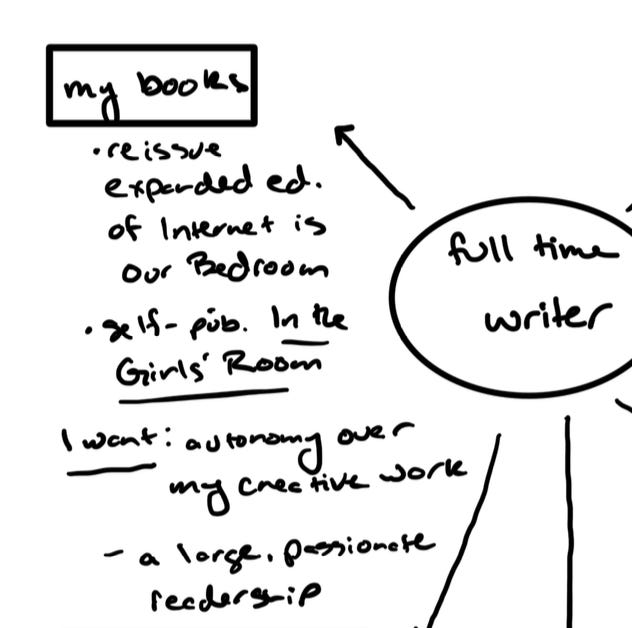
Because I had already built this space here on substack where I could make it happen.
So if you’re reading this and you want to write books that people will actually buy and read and you’ve clicked past a hundred get rich quick on newsletter cash articles on this app, this one is for you. Because I’m going to tell you how to use substack to get exactly what you want.
Books are my day job — I ghostwrite them. I edit them. I teach people how to write them and then how to pitch them or else how to self-publish them. I’ve been doing this full time for five years and before that I was in a PhD program and working in academic publishing which is an actual shit show — (I have one academic monograph published and I’ve never seen a single penny from that work) — and watching my friends (mostly cartoonists for some reason) land publishing deals, fail to deliver, and have to pay back their advances on the salary they made teaching at an art school (this is a true story).
And I can tell you, after being in and around the publishing industry most of my adult life, our girl trad publishing is different.
I had a friend who used to joke that the week he became a NYT Bestseller must have been a slow week because his book had sold something like 1,000 copies since its release. I think there is a misconception about traditional publishing that when you sign with a trad publisher, that is the ticket to fame, riches, and never having to put your phone on a tripod to tell the internet about your book.
For a very few, this is absolutely the case. But for most working writers who are traditionally publishing, you still have to put your phone on a tripod multiple times a day to tell the Internet about your book and you’re worried about how much your book is selling because your advance was essentially a loan that you now have to pay back in book sales and your fame is relative to how well you told the Internet about your book.
That is all your job now.
I was vaguely aware of this when I hit post on my first substack essay back in 2023, but as I continued to write my newsletter and figured out how to use social media to effectively promote it and even self-published my second book collecting essays I had written on here, I quickly realized that I’d much rather be doing this job than doing the job I would have to do as a traditionally published writer.
The truth is, writing on substack helped me hone my craft, learn the game that is the algo and the internet attention economy, and made me into the kind of writer who is unafraid of putting her face on camera and telling TikTok/Insta/YouTube exactly what she’s writing and why.
So if you want to start doing this job and get what you want by writing on the internet, here’s how to get started:
⋆˚☆˖° use your newsletter to write things you’re scared to write
When I published my first piece on Internet Bedroom — an essay about Euphoria and the evolution of TV for/about American teenagers — I was so scared to hit publish and send an essay where I talked about my ex-boyfriend yelling at me and saying terrible things to me on the daily to my dozen or so readers that I set up a meeting with my mom.
“I am publishing this essay on the Internet, and I am going to talk about how my ex-boyfriend yelled at me more than he spoke in a normal voice,” I told her, sitting at her kitchen counter, putting together a set of legos that were supposed to look like me and my fiancé at our wedding in a few months.
My voice was shaky, and I felt like I was admitting to what Zendaya’s character admitted to in The Drama.
Writing and publishing that essay freaked me out so much that I didn’t log into my substack account again for another nine months. I got married, moved to the woods, my dog went blind, and it was only after all that that I came back to my newsletter and realized that a meteor had not struck me down for telling the Internet that my ex-boyfriend used to yell at me. In fact, I had a letter in my inbox from said ex-boyfriend apologizing to me because he was back in AA and on Step 9.
My point is that all writing is scary to some degree. But writing on the Internet allows you to do the thing writers have been trying to do since the days of stone tablets: write something and see how people respond to it in real time.
So many of the ideas that form the core of my new book, In the Girls’ Room, I worked out through the essays that I wrote on this platform in 2024 and 2025. Because writing is a way of thinking and producing those pieces while I was also drafting my third book gave me a million opportunities to try out my thinking in public, which is something that the closed circuit of trad publishing and academia can only replicate.
⋆˚☆˖° understand that you are writing so that other people will read what you write
If you want to write a newsletter and a book that people will actually read, you must write stuff people want to read.
Yes — making art is about self-expression. But your job as a writer (or any kind of artist really) is to make your expression legible to actual people. It really doesn’t matter how beautiful your prose is, how nuanced and novel your insights. If you are not reaching people on an emotional level, you’re not really writing for anyone but you.
Basically, I learned how to write for the internet by watching this video:
You are writing for people. Start there.
⋆˚☆˖° don’t be lazy about your promo
Yeah if Kurt Cobain were alive, you wouldn’t be asking him to make content blah blah blah. I am a big hater of generic content as much as the next girl, but Kurt Cobain isn’t alive right now — you are. And you have this thing in your pocket that allows you to put your work in the hands of hundreds/thousands/millions of people on a random Tuesday.
Like it or not, social media, the Internet, algorithms and AI — these things aren’t going anywhere. But what you can do about that is make stuff. I think of my “content” as stuff — drafts, little ideas that I’m trying out to see what resonates with people. I think of posting on social media as an opportunity to refine what I want to say, how I want to say it, and the visuals I want to use to get people’s attention. And the cool thing is we get that opportunity to try to make stuff again and again and again.
So keep your heart pure, know when to stop scrolling and shut your phone off, and post about your work. What do I want to look at more: AI slop from the White House or you telling me about your art?
Exactly.
⋆˚☆˖° substack is a team sport, not a competition
This one is so important — arguably the most important thing you can learn when you’re writing on the Internet. It is so, so easy to slip into the trap of competing with other writers and artists as if the space they take up online somehow negates what you’re doing. And I’ll be so for real with you, there were moments in the first year I committed to writing on here where I was checking other writer’s subscriber counts or how many likes they got on a post and wondering why I wasn’t getting the same traction.
It’s a trap.
The writers and artists and creatives you meet online are not your competition. They are your teammates. You are here to make friends — but try to do that in a genuine way.
Read the writers you admire on here, read your friends who are on here, share their work and talk about them in the rooms they aren’t in. Find opportunities to put other people on without any expectation that you’ll get something in return. Learn how to celebrate when someone else writes something you wish you had written because whenever one of us writes something good, that’s a win for everyone and a slap in the face to AI.
We come up together. It’s the only way.
Lmk if you all want a follow-up to this guide about how to make the leap from writing on substack to self-publishing! And leave questions you have about substack in the comments. And thank you so so much to Kristina Nasti for suggesting I write about this — her newsletter CHEEKY is hilarious and you all need to subscribe to it right this moment.
As always thank you so so so much for reading and for PREORDERING my new books — truly mind-blowing to me that I’ve sold 500+ books at this point.
If you enjoyed this guide, I keep the really good stuff about writing, being a creative online, and navigating the attention economy behind my paywall:
god keeps me from going viral because she knows i'm too sensitive

welcome back to our internet bedroom. this is captive audience, my series for paid readers on making art (not content) online. and this issue is something of a manifesto for self-promo and virality on your terms.

I felt this article SO HARD. I started subscribing to your substack super recently, and mostly because getting my own bedroom about eighteen months before moving away from home was such a fundamental life-affirming moment for me that, I mean, how could I NOT want to subscribe to something called Internet Bedroom? But I keep coming back because of the way that you write about writing, like the process and pitfalls and paradise of it, and because it makes me fall for my own writing all over again.
Don't stop never stopping. Loved this post entirely. Thanks for sharing it!
You're an icon and a legend!! Love love lovedddd this post 💗